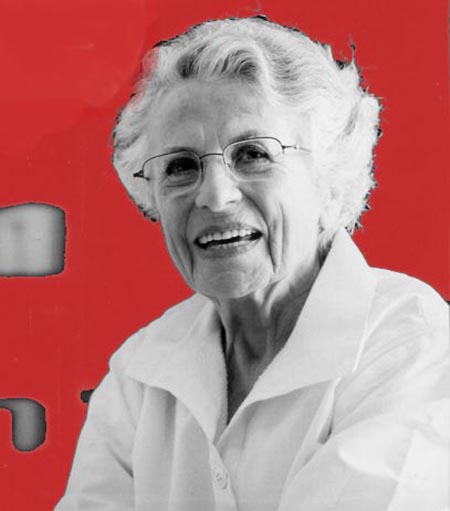
Marta Pan
1923 – 2008
Hungarian sculptor naturalized French
https://www.pan-wogenscky.com/
date of insertion in W.A.D. 12/2025
Biography
After studying art at the Ecole des Beaux-Arts in Budapest, she moved to Paris in 1946, where she met Constantin Brancusi and Fernand Léger.
In 1952, she married André Wogenscky, a collaborator of Le Courbosier.
Her close relationship with the architect influenced her artistic research in her sculptures, such as Le Teck (1956), which inspired the ballet of the same name by choreographer Maurice Béjart.
In 1952, Marta Pan and her husband purchased a plot of land a few kilometers from Paris and designed a modernist villa. Their artistic collaboration gave rise to a unique body of work, in which architecture and sculpture interact harmoniously. Marta Pan incorporates her sculptures in wood, marble, and steel, while André designs living and working spaces.
Her research often focuses on public spaces, allowing Marta Pan’s works to be placed in prominent contexts (near buildings such as Tokyo City Hall, the Yokohama Cultural Center, offices in Kobe, etc.), to characterize the main artery of a city undergoing reconstruction (Rue de Siam in Brest), or to participate in the pleasure of sharing the space of a square (in Paris, Riyadh, Tokyo, etc.).
Her entire body of work, exhibited in major museums, and her presence in Japan, has earned her the prestigious Imperial Prize.
After designing the models for the “Gates” series, she passed away in 2008
Curriculum
In 1953, he developed the Charnieres series. Starting from research inspired by organic forms, these are abstract, mobile, and modular sculptures.
From 1954 to 1960, Pan favored wood as his medium.
In 1961, he received his first commission from the Rijksmuseum Kröller-Müller in Otterlo, the Netherlands, Balance en deux from the Sculptures flottantes series, where he used new industrial materials such as anodized aluminum, plexiglass, and polyester.
In 1967 she designed the work “Sigle” for the Maison de la Culture in Grenoble. The sculptor created a concrete sculpture/acoustic wall, with the aim of combining aesthetics and functionality, characterising the side wall of a theatre hall with plastic and organic forms, typical of her abstract language, the result of the collaboration between Marta Pan and her husband, the architect André Wogenscky, also in collaboration with her husband in 1964 she had created a series of monumental sculptures for the Necker and Saint Antoine hospital in Paris.
In 1990, Marta Pan was invited to Celle, near Pistoia, Italy, by collector Giuliano Gori. She was asked to design a floating installation on the surface of the large lake that would not compromise the overall interpretation of the environment: the water, the island, and the surrounding forest. She created the floating sculpture Celle 2 forme, a bright red painted aluminum sculpture.
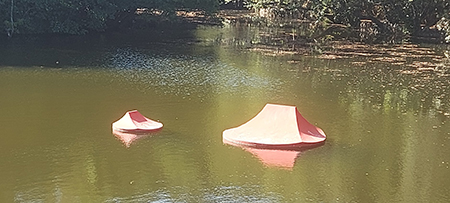
Floating sculpture Celle
1990 – alluminio verniciato
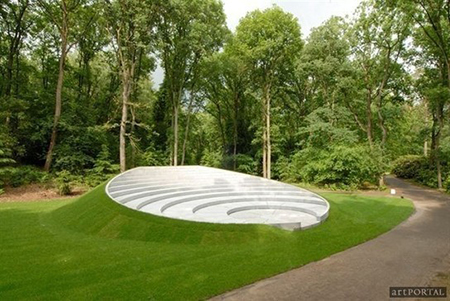
Amphitheatre
2005/2007 – Sculpture Park Kröller Müller, Netherlands
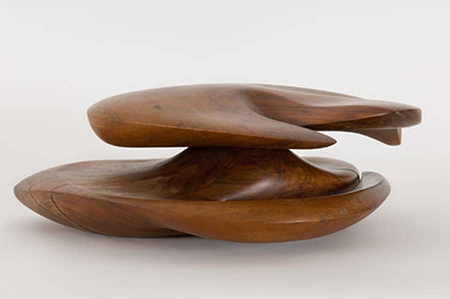
Balance en deux
1957 – scultura in noce in 2 pezzi
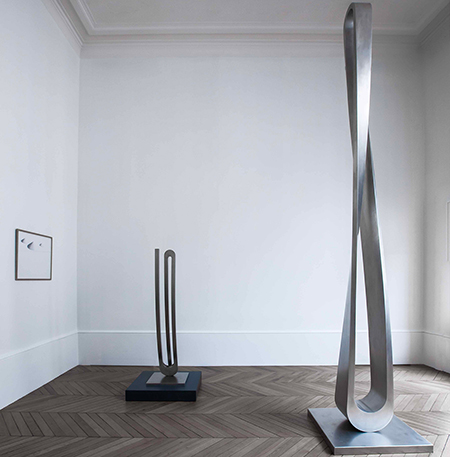
Le Signe infini
2002 – 140 x 23 x 23 cm e 55.1 x 9.1 x 9.1 – steel

Sculpture-flottante otterlo Museo Kroller-MüllerStagno
resina poliestere rinforzata con fibra di vetro, alluminio
