
Simone Forti
Born in 1935
USA/ Italia
https://en.wikipedia.org/wiki/Simone_Forti
https://old.centropecci.it/it/webtv/simone-forti-senza-fretta_1
date of insertion in W.A.D. 12/2025
Biography
The Formative Years (1935 – 1959)
Simone Forti was born in Florence in 1935 to Italian Jewish parents. Following the enforcement of Fascist racial laws, she moved with her family to Los Angeles, where she graduated from Reed College in psychology and sociology. In 1956, she settled in San Francisco with her first husband, the minimalist sculptor Robert Morris. In 1959, she moved to New York, where she studied at Martha Graham’s school and completed her training at Merce Cunningham’s studio, attending Robert Dunn’s composition classes.
The Avant-garde and the Dance Constructions (1960 – 1967)
Part of the anti-establishment culture, she debuted at the Reuben Gallery in 1960 with See-Saw and Rollers. In 1961, at Yoko Ono’s loft, she organized the historic evening Five Dance Constructions and Some Other Things (including pieces such as Huddle and Slant Board). These performances revolutionized the relationship between performer and spectator, using everyday gestures and interactions with objects.
After separating from Morris in 1962, she married the artist Robert Whitman, collaborating on his Happenings under the name Simone Whitman until 1968. From this period is the watercolor series Red Hat (1966), where a red hat became her distinctive sign, a symbol of the convergence between art and life.
The Roman Period and the Study of Nature (1968 – 1969)
In 1968, after her divorce from Whitman, she settled in Rome, where she collaborated with gallery owner Fabio Sargentini at L’Attico. There, she presented a retrospective of her Dance Constructions and created new works such as Bottom, Book, and Fallers.
During this period, she developed “Sleep Walkers” (or Zoo Mantras), born from observing animal movements at the Rome Zoo (now Bioparco). Influenced by her studies with Anna Halprin, she reproduced the movements of flamingos, polar bears, and elephants onto her own physical structure. In 1969, she collaborated with the theatrical group “Lo Zoo.”
Holograms and News Animations (1970 – 1999)
In 1970, she returned to California, living with artists such as Nam June Paik and the musician Peter Van Riper, her future husband. In 1976, thanks to a meeting with physicist Lloyd Cross, she began experimenting with holography, creating integral holograms (such as Striding/Crawling and Angel) that show three-dimensional moving images.
Between the 80s and 90s, she developed “News Animations,” a series of improvisations blending movement and word (Logomotion) to reflect on politics, climate, and social issues. From 1986 to 1991, she performed with “Simone Forti and Troupe.”
Recent Collaborations and Recognition (2000 – Today)
Since the 2000s, she has collaborated intensely with writer Fred Dewey and the group “The Sleeves,” producing shows like Unbuttoned Sleeves (2005) and publishing several books. Her work is currently held in the collections of MoMA in New York and the Stedelijk Museum in Amsterdam. Throughout her long career, she has received prestigious awards, including:
• Guggenheim Fellowship (2005)
• Yoko Ono Lennon Award for Courage in the Arts (2011)
• Golden Lion for Lifetime Achievement at the Venice Dance Biennale (2023)
Curriculum
Riconoscimenti e Premi
• 2023: Leone d’Oro alla carriera (Danza), Biennale di Venezia.
• 2015: Anonymous Was A Woman Award.
• 2011: Yoko Ono Lennon Courage Award for the Arts.
• 2008: CHIME Grant (Choreographers in Mentorship and Exchange), Los Angeles.
• 2005: John Simon Guggenheim Memorial Foundation Fellowship (Coreografia).
• 2003: Lester Horton Lifetime Achievement Award (Dance Resource Center of Los Angeles).
• 1995: Bessie Award (New York Dance and Performance Award) per i risultati ottenuti.
• 1988: NYSCA Grant per la coreografia.
• 1985: Australia Council Theatre Board Award.
• 1980: NEA Choreographer’s Fellowship.
• 1976: NEA Grant per la coreografia & NYSCA CAPS Grant.
Esposizioni e Performance Selezionate
Il lavoro di Simone Forti è stato presentato nelle istituzioni più prestigiose al mondo, tra cui:
• New York: MoMA (varie edizioni dal 1978 al 2018), Guggenheim Museum (2013), Whitney Museum (2001), P.S.1 (1976-1983).
• Parigi: Centre Pompidou (2015), Museo del Louvre (2014), Fondation Cartier (2002).
• Italia: Galleria L’Attico, Roma (1968-2008), Castello di Rivoli, Torino (1999).
• Los Angeles: Hammer Museum (2013, 2015), Getty Museum (2004).
• Altre sedi: Kunsthaus Zurigo, Reina Sofía Madrid, Hayward Gallery Londra, MAMCO Ginevra.
Selezione delle Opere (Cronologia sintetica)
1960 — 1970 (Le Origini)
• 1960: See Saw, Rollers, Demon.
• 1961: Slant Board, Huddle, Hangers.
• 1968: Sleep Walkers, Largo Argentina (video).
1971 — 1989 (Sperimentazione e Ologrammi)
• 1971: Illuminations (con Charlemagne Palestine).
• 1976: Planet, Angel (ologramma), Green Green.
• 1977: Serie di ologrammi integrali (Movements, Figure 8, Dancer).
• 1986: Logomotion, News Animations.
1990 — 2016 (Collaborazioni e Video)
• 2000: Tree Improvisation (video).
• 2007: Turtles All The Way Down (con ensemble “The Sleeves”).
• 2012: That Fish is Broke.
• 2015: Flag in the Water (video), Flowers and Vessel.
• 2016: Journey Dream Flower.
Desideri approfondire una sezione specifica, come il dettaglio delle collaborazioni o la lista completa dei video?

Huddle
1961 – Performance. 10 min. The Museum of Modern Art, New York. Committee on Media and Performance Art Funds. © 2019 The Museum of Modern Art, New York

Vicino al CuoreClose to the Heart
2019 – installation view, Fondazione ICA Milano – Ph. Filippo Armellin

Vicino al CuoreClose to the Heart
2019 – installation view, Fondazione ICA Milano – Ph. Filippo Armellin

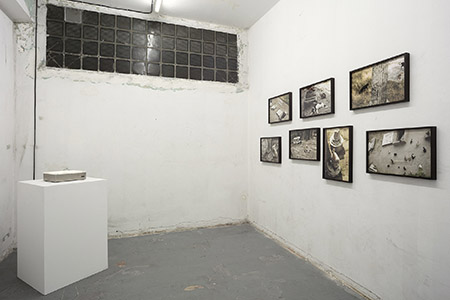
Vicino al CuoreClose to the Heart
2019 – installation view, Fondazione ICA Milano – Ph. Filippo Armellin